
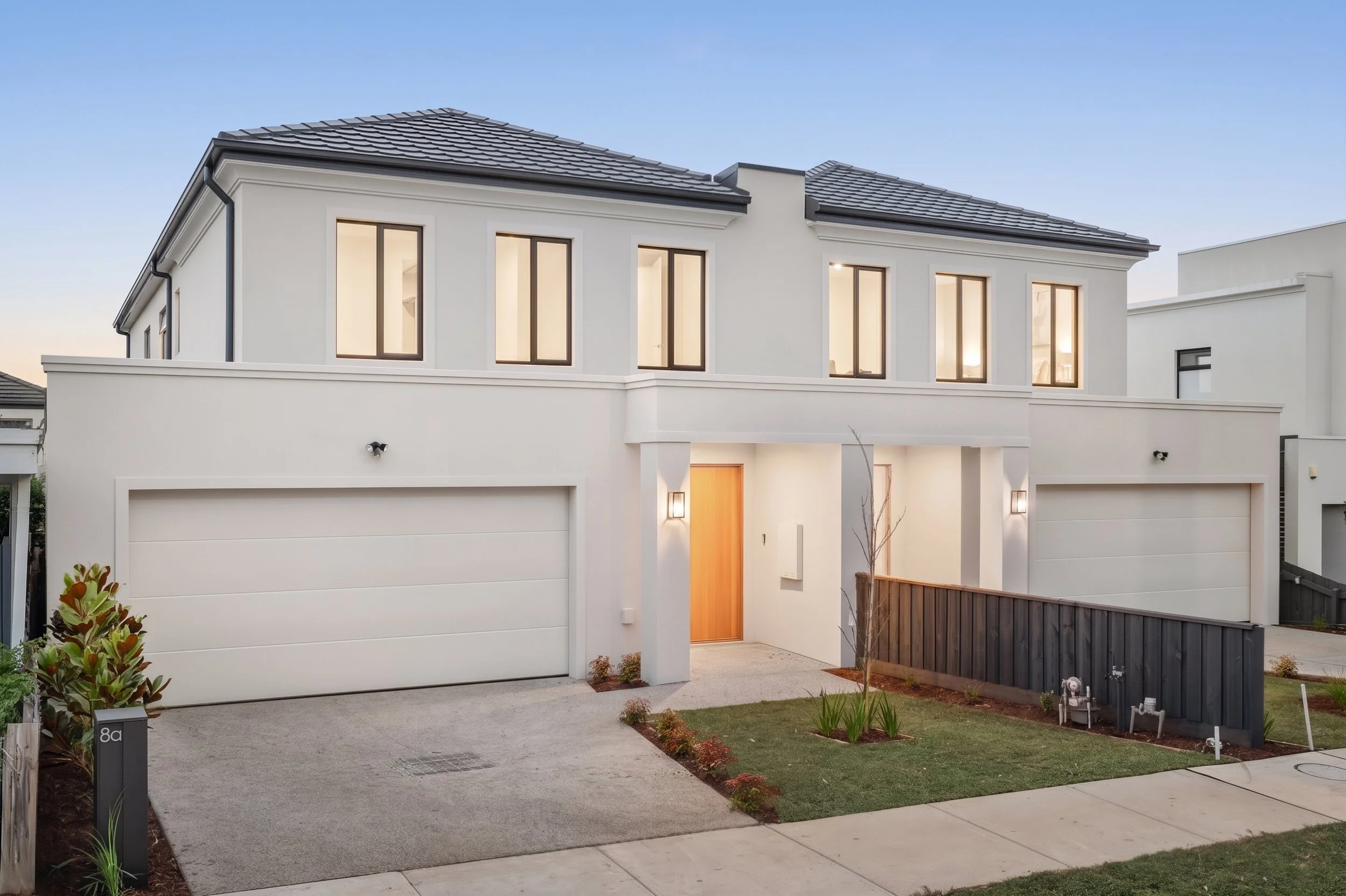
How Much Does It Cost to Build a Dual Occupancy or Duplex in Melbourne (2026)?
As a practical guide, dual occupancy construction in Melbourne’s eastern suburbs generally starts from around $25,000 + GST per square for a more cost-conscious specification, plus site works.
For a mid- to high-end finish, a more realistic allowance is approximately $30,000–$35,000 + GST per square, again excluding site-specific works.
Highly architectural, bespoke or particularly complex homes can exceed these rates.
For example, for a 30-square dwelling, this equates approximately to:
| Specification | Indicative Rate | 30-Square Example |
|---|---|---|
| Cost-conscious | $25,000 + GST / sq | $750,000 + GST |
| Mid-range | $30,000 + GST / sq | $900,000 + GST |
| Higher specification | $35,000 + GST / sq | $1.05m + GST |
Indicative construction rates only. Site works, demolition, planning, consultants, authority fees, subdivision, finance and other development costs are additional. Architectural or highly bespoke builds may exceed these rates.
Construction Cost Isn't the Total Development Cost
The construction rate is only one part of the overall development budget.
A proper feasibility should also allow for site works, demolition, planning and consultants, authority and subdivision costs, finance and holding costs, selling costs and GST.
Site-specific items such as slope, retaining, drainage, sewer locations and difficult access can also materially affect the final result.
That is why the more important question is not simply “How much will it cost to build?” but:
“Once all costs and expected resale values are considered, does the project actually stack up?”
That is the question our feasibility studies are designed to answer.
Want to Know Whether Your Site Stacks Up?
Tell us a little about your property and what you are considering. We’ll review the site and contact you to discuss whether a detailed development feasibility would be worthwhile.
What Happens After the Feasibility?
If the numbers stack up and you decide to proceed, the next step is usually concept design, planning and detailed project development.
Vector Homes can manage the process from the initial feasibility through to dual occupancy design, planning and construction, giving you continuity between the commercial assumptions made at feasibility stage and the homes that are ultimately designed and built.
You can learn more about our dual occupancy design and build approach below.
What Affects Dual Occupancy Build Costs?
Build costs can vary considerably even between projects of a similar size. The main drivers are:
Site conditions — slope, excavation, retaining walls, soil conditions, drainage and access.
Design complexity — articulated layouts, complex roof forms, cantilevers and structural requirements.
Specification and finishes — kitchens, bathrooms, joinery, appliances, flooring, windows and external materials.
Planning constraints — trees, easements, setbacks and other site requirements that can make the design less efficient.
Services and infrastructure — sewer, stormwater, power and other authority requirements.
Architectural detail — highly bespoke or premium designs can exceed standard build-rate allowances.
For this reason, $25,000–$35,000 + GST per square is best used as an early budgeting guide rather than a fixed construction price.
“Vector helped us understand what was actually achievable on our site before we committed to design. The process was clear, and the end result exceeded expectations.”
- Valeo N, DonvalePlanning a Dual Occupancy in Melbourne’s Eastern Suburbs?
A successful dual occupancy project starts with more than a build rate. Site dimensions, planning controls, slope, trees, drainage, orientation, and likely resale values can all influence what makes sense on a particular property.
If you're considering developing your property, use the form above to send us the address and a brief outline of what you're thinking.